Determination of Total Carbon in Soil by Dry Combustion (Elementary Analysis) with Sundy SDCHN636 Carbon, Hydrogen and Nitrogen Analyzer According to ISO 10694
Introduction
Soil serves as the material foundation of agricultural production and an important carrier for the survival and reproduction of living organisms. With the continuous advancement of science and technology, particularly the deepening understanding of soil functions and their ecological roles, the perspective of contemporary soil material cycling helps reveal the biogeochemical nature of elements in soil. This understanding has led to greater emphasis on the importance of dynamic changes in soil nutrient elements in agricultural and ecological systems.
Carbon, as the fundamental constituent element of all organic matter in nature, occupies a central position in the soil biogeochemical cycle. Studies have shown that the soil carbon pool is not only a key component of the global carbon balance but also an important factor in maintaining ecological stability. Current research on soil carbon mainly focuses on its forms, activity, and interactions with global change, highlighting the importance of understanding the soil carbon cycle for addressing climate change.
Method Reference
ISO 10694 Soil quality — Determination of organic and total carbon after dry combustion (elementary analysis)
Principle
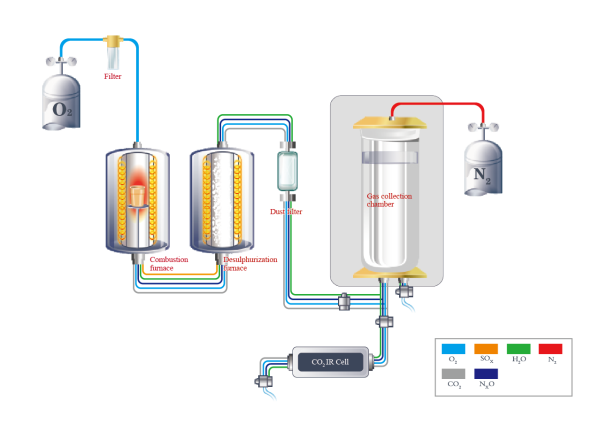
The carbon present in the soil is oxidized to carbon dioxide (CO2) by heating the soil to at least 900 °C in a flow of oxygen-containing gas that is free from carbon dioxide. The amount of carbon dioxide released is then measured by using an infrared detection method.