

Determination of Gross Calorific Value in Coal and Coke with Sundy SDAC1200 Bomb Calorimeter According to ISO 1928
Introduction
Coal and coke, as the solid fuels and industrial raw materials, are widely applied in power generation, steel-making, cement production and other industrial sectors. Calorific value is one of the most critical indicators for evaluating the quality of coal and coke, since it defines energy content, guides combustion control and supports fuel pricing and trade settlement. Coal and coke of different origins and ranks show considerable variations in properties, making accurate calorific value testing essential for quality control and efficient utilization. This paper focuses on the practical testing of calorific value for coal and coke in accordance with ISO 1928 to support its industrial application.
Method Reference
ISO 1928 Coal and coke – Determination of gross calorific value
Principle
A measured portion of the general analysis sample is burned in high-pressure oxygen in a combustion vessel calorimeter under specified conditions. The effective heat capacity of the calorimeter is determined in calibration tests by combustion of certified benzoic acid under similar conditions. The gross calorific value is calculated from the corrected temperature rise and the effective heat capacity of the calorimeter, with allowances made for contributions from ignition energy, combustion of the fuse(s) and for thermal effects from side reactions such as the formation of nitric acid. Furthermore, a correction is applied to account for the difference in energy between the aqueous sulfuric acid formed in the combustion vessel reaction and gaseous sulfur dioxide, i.e. the required reaction product of sulfur in the fuel.

Reagents
Oxygen: at a pressure high enough to fill the combustion vessel to 3 MPa, pure, with an assay of at least 99.5 % volume fraction, and free from combustible matter.
Ignition wire: of nickel-chromium ~0.1 mm in diameter.
Water: deionized, distilled or water of equivalent purity, with a specific conductivity not higher than 0.2 mS/m at 25 °C.
Benzoic acid: of calorimetric-standard quality, certified by a recognized standardizing authority (or with unambiguously traceable certification).
Sample Preparation
The coal and coke used for the determination of the calorific value shall be the general analysis sample ground to pass a test sieve with an aperture of 212 µm and shall be prepared in accordance with ISO 13909-4 and ISO 18283. In some circumstances, it has been shown that a maximum particle size of 250 µm is acceptable for low- and medium-rank coals.

Testing Parameters
Internal volume of the combustion vessel: 300 mL
Distilled water: (1 ± 0.1) mL
Ignition heat: 50 J
Oxygen pressure: (3.0 ± 0.2) MPa
Oxygen time: 15 s
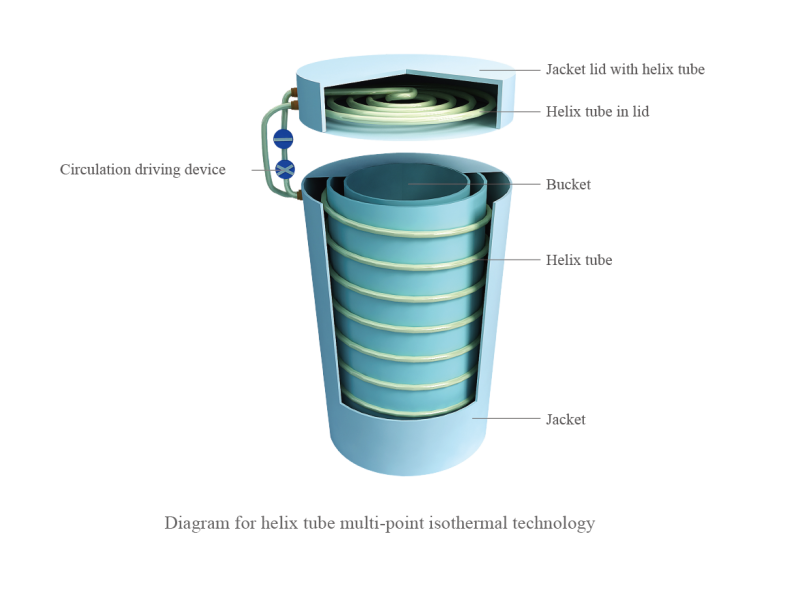
Ambient temperature: 22 °
Jacket temperature: 28 °C
Bucket temperature: 26 °C
Water tank temperature: 24 °C
Procedure
(1)Instrument Preparation
Prepare the instrument and the combustion vessel as outlined in the operator manual.
(2)Calibration of Calorimeter Heat Capacity
a. Select “Heat capacity” test mode in the instrument software.

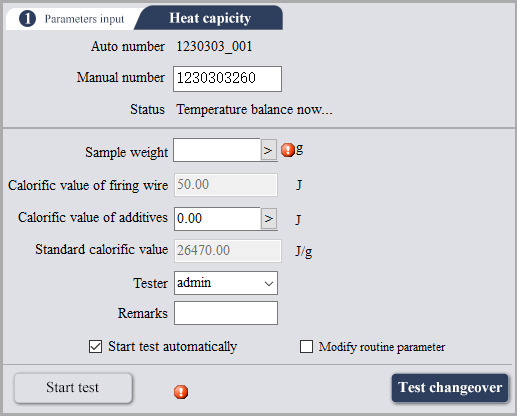
b. Weigh ~1.0 g benzoic acid and perform heat capacity tests.
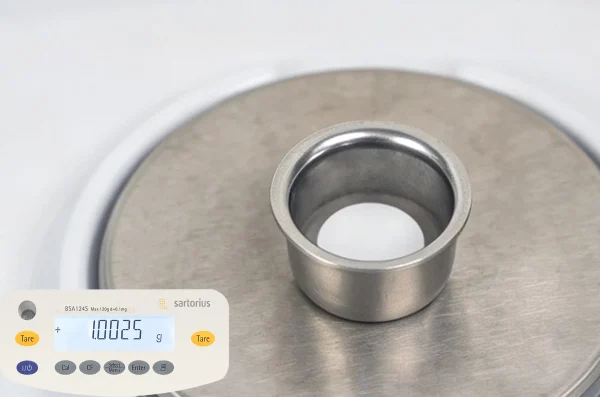
c. Repeat the heat capacity test five times.
When the standard deviation, s, shall not exceed 0.20 %, (All results from the current series of calibrations shall be included in the calculations; only tests with evidence of incomplete combustion shall be discarded.)
(3)Valid Working Range of the Effective Heat Capacity
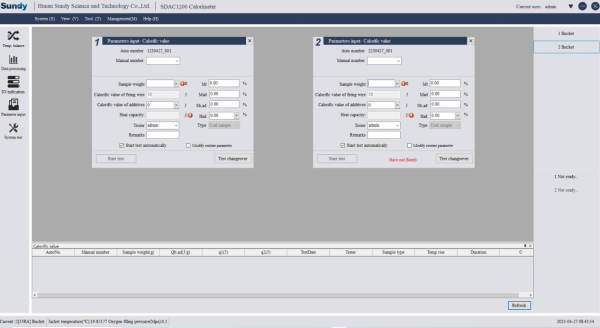
Select “Calorific value” test mode in the instrument software.
The mean values from triplicate runs on 0.7 g and 1.3 g benzoic acid masses, respectively, are compared with the certificate values.
Refer to the operator instruction manual for the determination of calorific value.
(4)Determination of Gross Calorific Value
Select “Calorific value” test mode in the instrument software.
Duplicate combustions shall be made. Usually 1g of coal or coke is the appropriate test portion. For high-ash coals and certain unreactive cokes, optimum conditions for clean combustions may be investigated by varying the amount of sample.

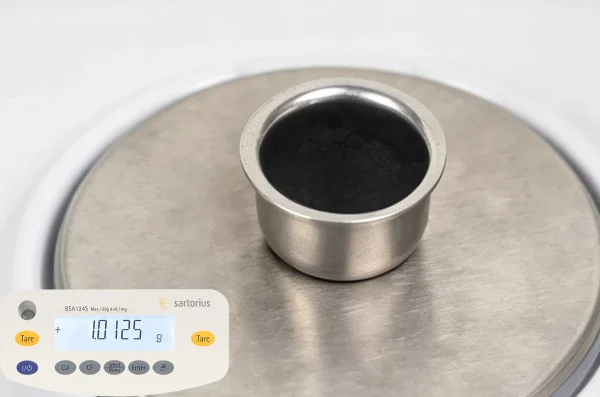
Refer to the operator instruction manual for the determination of calorific value. Coal and coke samples be corrected for sulfur and moisture content. Enter the as received sulfur value and the as determined moisture value into the respective columns in the SDAC1200 software.
The nickel-chromium crucible shall be lined with a commercially produced ash-free, silica-fibre disk, or something equivalent for coke, anthracite, high-ash coal and other less reactive fuels.
Typical Results
| Sample ID | Mass (g) | qV,gr,d (J/g) | Diff. (J/g) | Repeatability limit (J/g) |
| 1# | 1.0246 | 30470.26 | 76.00 | 120 |
| 1.0349 | 30546.26 | |||
| 2# | 1.0423 | 15379.08 | 1.21 | 120 |
| 0.9663 | 15377.87 | |||
| 3# | 0.9870 | 21204.61 | 70.51 | 120 |
| 0.9378 | 21275.12 | |||
| 4# | 1.0647 | 25939.68 | 59.77 | 120 |
| 0.9585 | 25879.91 |
Summary
The experimental results confirm that the test repeatability of four coal and coke samples falls within the repeatability limits specified by the standard, proving that the Sundy SDAC1200 calorimeter is fully compliant with .
For more information about the Sundy SDAC1200 Bomb Calorimeter, please contact us by phone or email.
Phone: +86-731-88112150
Email: sales@sundytech.com
